Restaurant SOP Guide: Write Procedures Staff Actually Follow
Learn how to write restaurant SOPs staff will actually follow — opening, closing, kitchen workflow, service standards, and a simple SOP template you can copy.
Executive Summary
A restaurant SOP (standard operating procedure) is a short, step-by-step standard for a repeatable task. Start with:
- Opening
- Closing
- Critical food-safety tasks
- Top guest-facing procedures (ticket flow, complaint recovery, cash close)
- One high-variance kitchen build if quality swings by cook
Keep each SOP to roughly one page and 5–9 steps. Train to it (staff training), inspect it, and review monthly. Pair daily open items with your opening checklist.
⚠️ Local rules vary. Food-safety steps must meet your local health code. This guide is educational, not a substitute for local regulatory requirements.
Introduction
SOPs turn “how we do it here” into trainable, inspectable work. Without them, every trainer teaches a slightly different restaurant. Guests notice. New hires drown. Managers answer the same questions every shift.
This guide shows how to write restaurant standard operating procedures people will actually follow — short, station-visible, owned, and versioned — plus a copyable template and two filled examples.
For how SOPs fit the wider system, see restaurant operations.
Why This Matters
Well-written restaurant SOPs deliver:
| Benefit | What you gain |
|---|---|
| Consistency across shifts | Same open, same plate, same close |
| Faster onboarding | Train to a document, not tribal memory |
| Fewer manager interruptions | Answers live at the station |
| Safer food handling | Critical steps are explicit |
| Easier improvement | You can change one document, retrain once |
SOPs are not corporate theater. In independents, they are how quality survives turnover.
Step-by-Step Guide: Create Your SOP Library
Step 1 — Pick critical processes only
List every recurring task, then rank by risk × frequency × variance. Start with 5–7. Expand later.
Typical first library:
- Opening procedure
- Closing procedure
- Kitchen ticket / expo flow
- Cash drawer open and close
- Cooling / temp logging (or your highest food-safety risk)
- Guest complaint recovery
- One signature menu item build
Step 2 — Draft 5–9 clear steps
Each step should be an action someone can do without asking a manager. Include:
- Tools or stations needed
- Temps, times, or counts where relevant
- What “done” looks like
Avoid novels. If a step needs a paragraph, split it or add a photo callout.
Step 3 — Add exceptions and escalation
Write what to do when reality breaks: 86 item, equipment down, cash variance, guest allergy. Name who to call.
Step 4 — Assign a document owner
Every SOP needs a human owner (often GM or chef) responsible for accuracy and review date — not “the team.”
Step 5 — Train, then audit
Train using the SOP (training system). Spot-check monthly. If people skip a step, either fix the process or remove the fiction.
Step 6 — Version and store where work happens
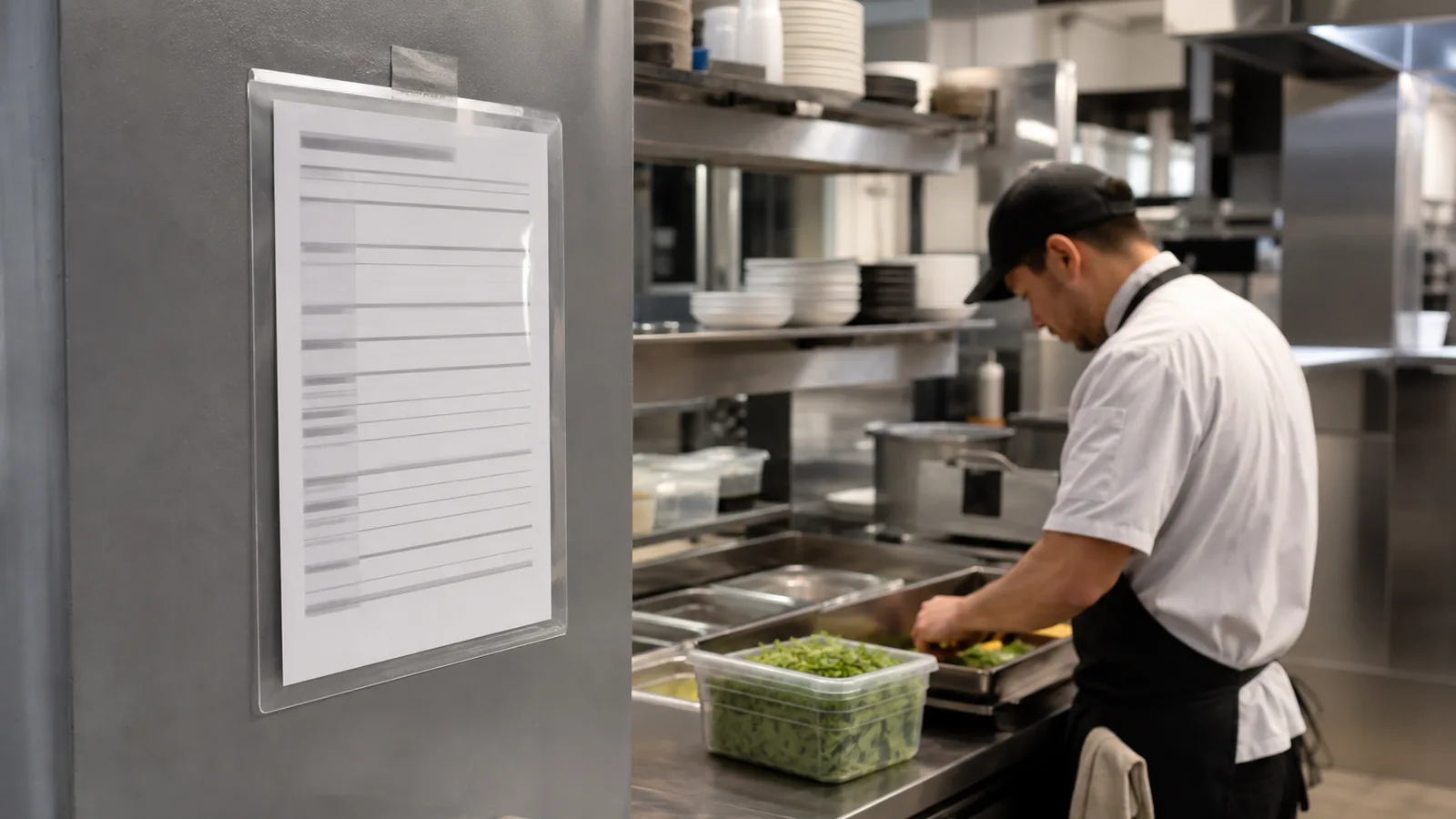
Put a date on every SOP. Store printed copies at the station or on a tablet at the pass — not only in email.
---
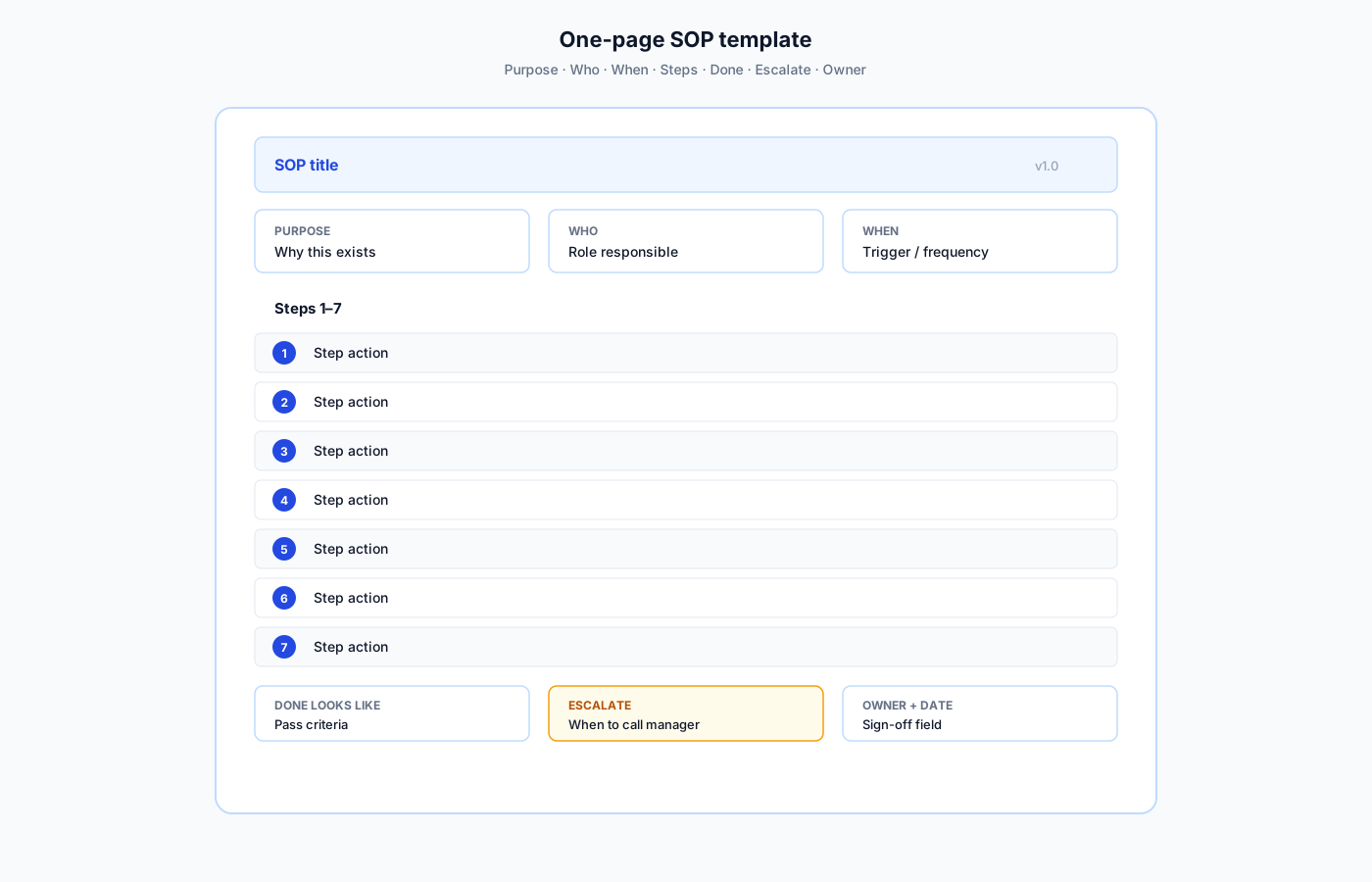
Practical asset — One-page SOP template
SOP TITLE: ________________________________
Purpose: _________________________________
Who performs: ____________________________
When: ____________________________________
Tools / stations: ________________________

Steps:
1.
2.
3.
4.
5.
6.
7.

Quality check (what “done” looks like):
Exceptions / escalate to:
Document owner: ________  Version date: ________
Framework: One-Page SOP Anatomy
Every restaurant SOP should fit the same skeleton so staff recognize the pattern across stations.
| Block | Required content |
|---|---|
| Header | Title, purpose, who performs, when |
| Tools / stations | What must be present before step 1 |
| Steps (5–9) | Numbered actions; include temps, times, counts |
| Quality check | What “done” looks like (observable) |
| Exceptions | 86s, equipment down, allergy, cash variance — who to call |
| Ownership | Document owner + version date |
Library build order (risk × frequency × variance)
- Opening · 2. Closing · 3. Critical food-safety · 4. Ticket/expo flow · 5. Cash open/close · 6. Guest complaint recovery · 7. One high-variance menu build
Checklists confirm; SOPs teach. Pair with your opening checklist and training path.
Best Practices
- Short beats complete. One page people use beats ten pages people ignore.
- Write with the best operator, not only the owner. Capture how the work really happens, then raise the standard.
- Align with the handbook. SOPs must not contradict attendance or safety policies in the employee handbook.
- Update when the menu changes. New item = new or revised build SOP.
- Audit monthly. Pick three SOPs; watch one shift perform them.
- Connect to checklists. Checklists confirm; SOPs teach. Use both with your opening checklist.
- Version visibly. Date every page; retire old printouts the day a new version ships.
- Train before you enforce. An unread SOP is not a performance standard.
Common Mistakes
- Writing SOPs nobody trains — unread PDFs are decoration.
- Updating the menu without updating the SOP — variance returns overnight.
- SOPs that contradict the handbook — staff learn to ignore both.
- Too much detail — novels do not get read during a rush.
- No owner / no date — stale procedures become dangerous.
- Skipping closing SOPs — messy closes create unsafe opens (a classic first-year mistake).
Practical Examples
Example A — Opening SOP (filled skeleton)
| Field | Content |
|---|---|
| Purpose | Ready FOH/BOH for first seating safely and on time |
| Who | Opening shift lead + assigned openers |
| When | Every service day, before doors |
| Steps | 1) Disarm / unlock per security SOP 2) Log cooler/freezer temps 3) Verify hand sinks stocked 4) Power POS and test print 5) Count drawer float 6) Confirm mise for first rush 7) FOH set and restrooms ready 8) Pre-shift briefing 9) Manager walk-through |
| Done | Checklist signed; first tickets can fire without hunting tools |
| Escalate | Temp out of range → do not serve affected product; call GM |
Example B — Closing SOP (filled skeleton)
| Field | Content |
|---|---|
| Purpose | Secure food, cash, and building; set up tomorrow’s open |
| Who | Closing shift lead + closers |
| When | End of every service |
| Steps | 1) Last ticket cleared / 86 board updated 2) Cool and store leftovers per food-safety SOP 3) Clean stations to standard 4) Restock pars for open 5) Count drawer; reconcile POS 6) Trash/linens out 7) Lights/HVAC/security set 8) Closing checklist signed |
| Done | Openers can start without fixing yesterday’s mess |
| Escalate | Cash variance over threshold → notify GM before leaving |
Example C — Guest complaint recovery
| Field | Content |
|---|---|
| Purpose | Recover the guest without improvising comps |
| Who | Server + shift lead |
| Steps | 1) Listen without interrupting 2) Restate the issue 3) Apologize for the experience 4) Offer house-approved remedy tier 5) Notify kitchen if remake 6) Manager visit if guest still unhappy 7) Log reason code for weekly review |
| Done | Guest leaves with a clear resolution; void/comp coded |
| Escalate | Allergy incident or unsafe food → manager + stop service of item |
Example D — Kitchen ticket / expo flow
- Ticket prints / appears on KDS at the correct station
- Lead acknowledges and assigns priority (course timing)
- Station cooks to build card / recipe SOP
- Expo checks plate against ticket (modifiers, allergens)
- Runner / server delivers; ticket marked complete
- 86s communicated to FOH immediately when stock hits threshold
Example E — Cash close
- Run end-of-shift report
- Count drawer with a second person when possible
- Record variance; escalate above house threshold
- Secure cash per house policy
- Reset float for next open
- Sign closing checklist cash line
Example F — Cooler temp logging (food-safety critical)
| Field | Content |
|---|---|
| Purpose | Catch unsafe storage before service |
| Who | Opening lead (and mid-shift if required by house policy) |
| When | Before doors; again if equipment alarms or power blip |
| Steps | 1) Check each cooler/freezer listed on the open checklist 2) Record temp and time on the log 3) Compare to house range posted on unit 4) If out of range, do not use affected product 5) Call GM / repair path 6) Retest after corrective action 7) Initial the log |
| Done | Every unit logged; out-of-range units isolated |
| Escalate | Any out-of-range reading → stop and call GM before service |
Write temps to your local health-code requirements — this pattern is educational, not a code substitute.
Action Checklist
- [ ] Rank processes by risk × frequency × variance; pick first 5–7
- [ ] Copy the one-page template for each; keep 5–9 steps
- [ ] Fill opening, closing, ticket flow, cash close, and one food-safety SOP
- [ ] Add complaint-recovery and one signature build SOP
- [ ] Assign a document owner and version date on every SOP
- [ ] Place laminated or tablet copies at the station
- [ ] Train and sign off using staff training
- [ ] Spot-audit three SOPs this month; fix fiction or remove steps
- [ ] Align wording with the employee handbook
- [ ] Review SOPs after every menu, layout, or equipment change
Frequently Asked Questions
What is a restaurant SOP vs a checklist?
An SOP teaches how. A checklist confirms that required items happened. You need both for open, close, and food safety.
How many SOPs does a small restaurant need to start?
Usually 5–7 critical procedures. Add more only after those are trained and followed.
Who should write SOPs — owner or staff?
Draft with the people who do the work; the owner or GM approves the standard. Pure top-down SOPs often miss real constraints.
How detailed should each step be?
Detailed enough that a newly signed-off employee can succeed without asking — not so detailed that the page becomes unread.
How often should SOPs be reviewed?
At least monthly for critical food-safety and cash SOPs; after any menu, layout, or equipment change for the rest.
Should SOPs be printed or digital?
Either works if they are at the station and versioned. Many independents use laminated one-pagers plus a master digital file.
What’s an example kitchen SOP structure?
Purpose → who/when → tools → numbered steps (including temps/times) → plating/quality check → exceptions → owner/date. Same template as FOH.
Related Guides
- Restaurant Operations — Where SOPs sit in the ops stack
- Restaurant Opening Checklist — Daily open companion to opening SOPs
- Restaurant Staff Training — Train and sign off to the SOP
- Employee Handbook for Restaurants — Policies vs procedures
- Common Restaurant Mistakes — What happens when SOPs are missing
- How Restaurants Can Get More Customers — Growth after procedures stick
- Restaurant Knowledge Hub — Ops + Growth lanes
- About WhateverAsk — How we write experience-driven Knowledge Products
Conclusion
Restaurant SOPs work when they are short, trained, inspected, and owned. Start with opening, closing, food safety, and a few guest-facing procedures. Use the one-page template, put documents where work happens, and improve one SOP a week. That is how procedures stick — and how restaurant operations stop depending on a single hero.
Last Updated
2026-07-10. Educational guide for operators. Not legal or health-code advice. Align food-safety steps with your local authority requirements.