Restaurant Operations: The Complete Guide for Owners and Managers
Learn how restaurant operations really work — daily systems, staffing, SOPs, opening routines, and the mistakes that quietly kill margins. Practical guide for owners and managers.
Executive Summary
Restaurant operations are the systems that make food, service, and labor consistent every shift — not the owner’s personal hustle. A working ops stack covers:
- Opening and closing routines (Restaurant Opening Checklist)
- Written procedures for repeatable work (Restaurant SOP Guide)
- Training that certifies people to those procedures (Restaurant Staff Training)
- Clear expectations and policies (Employee Handbook for Restaurants)
- A habit of catching and fixing recurring errors (Common Restaurant Mistakes)
If knowledge lives only in one person’s head, you do not have operations — you have tribal knowledge. Tribal knowledge breaks the first time that person is sick, quits, or covers two stations at once.
⚠️ Local rules vary. Food safety, labor, and employment requirements differ by city, state, and country. Confirm requirements with your local health and labor authorities before enforcing policies.
Introduction
Most new owners confuse working hard in the restaurant with running restaurant operations. Working hard means you cook, serve, fix the POS, and close the drawer yourself. Running operations means the same outcomes happen when you are not on the floor.
This pillar page is the map of the full ops stack. Use it to decide what to build first, then dive into the supporting guides for checklists, SOPs, training, handbooks, and first-year mistake patterns. The goal is a repeatable loop: open → service → close → improve.
Independent restaurants rarely fail because the food idea was bad. They struggle because every shift reinvents how work gets done. Guests feel that as inconsistency. Staff feel it as chaos. Owners feel it as never being able to leave.
Why This Matters
Strong restaurant operations management protects five things that thin margins cannot afford to lose:
| Area | What ops protects | What weak ops costs |
|---|---|---|
| Consistency | Same plate, same timing, same greeting | Complaints, weak reviews, rework |
| Food safety | Temps, handwashing, allergen handling | Health risk, failed inspections |
| Labor cost | Clear roles, less overtime from chaos | Overstaffing or panic overtime |
| Guest experience | Predictable service standards | One-star “slow / rude / wrong order” nights |
| Manager bandwidth | Fewer “how do we do this?” interruptions | Owner stuck on every decision |
Undocumented processes also raise turnover. New hires learn by watching whoever is free that day. Two weeks later, three people do the same task three different ways. Retraining becomes constant. Managers burn out answering the same questions.
Ops excellence is not bureaucracy for its own sake. It is how you buy back time and protect quality when volume spikes.
The cost of “we’ll remember”
Independent restaurants often skip documentation because the founding team “just knows.” That works until the first vacation, the first double call-out, or the first menu change. Then the restaurant pays in comps, overtime, and owner hours. Writing the system once is cheaper than re-explaining it every shift for a year.
Restaurant systems and processes also make performance coaching fair. Without a standard, feedback sounds personal. With a standard, feedback points to a document both people can see.
Step-by-Step Guide: Build the Ops Stack
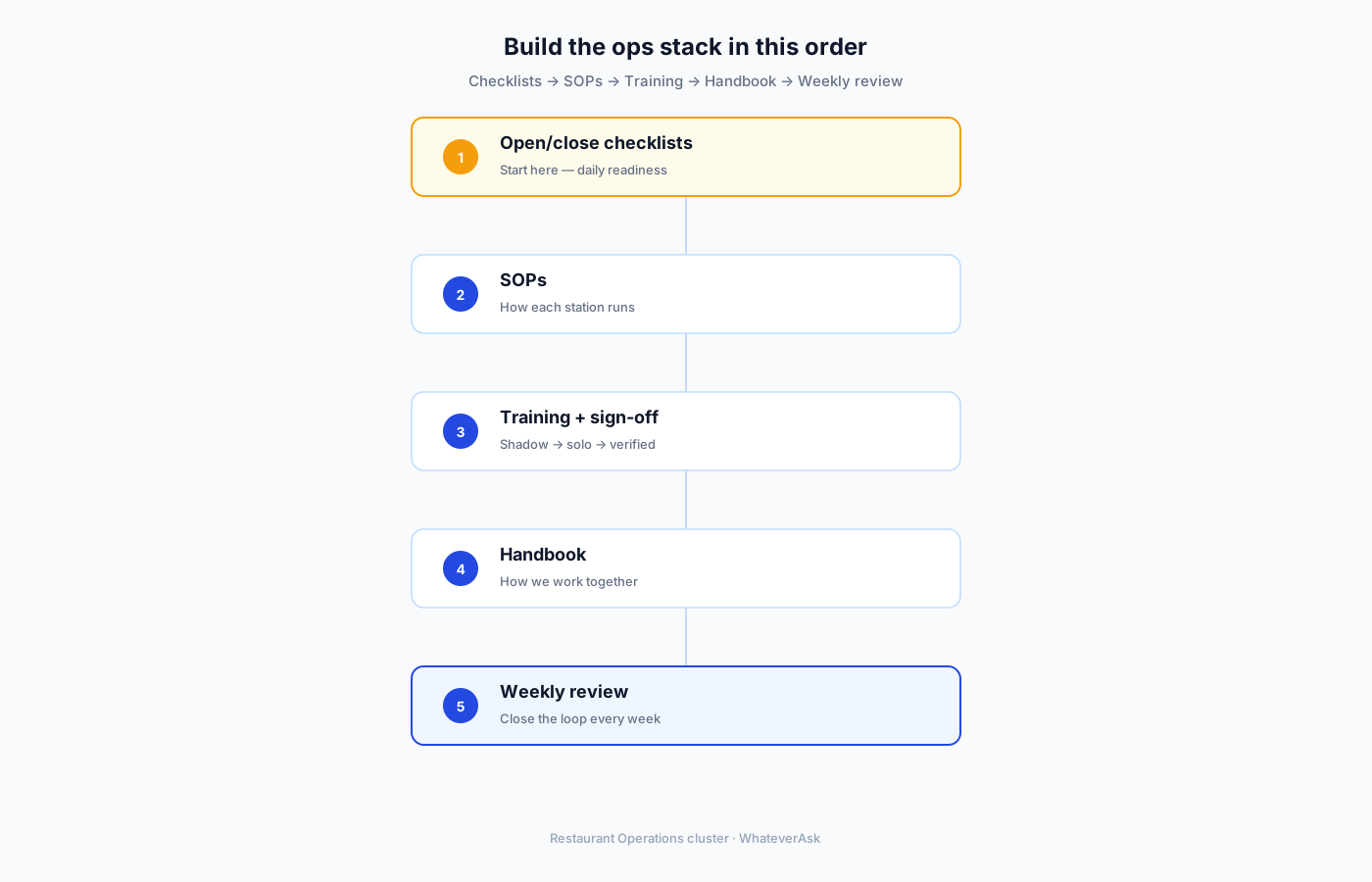
Build in this order. Skipping ahead (for example, training before SOPs exist) creates busywork that does not stick.
Step 1 — Define your service model and roles
Write one page that answers:
- Service style (QSR, fast casual, full service, delivery-heavy)
- Hours and peak windows
- Stations and roles (host, server, bartender, line, prep, dishwasher, shift lead)
- Who owns open, mid-shift, and close
Without role clarity, every later document fights ambiguity. This page becomes the spine for your employee handbook and training paths.
Step 2 — Write opening and closing checklists
Checklists are the daily spine of restaurant daily operations. Separate:
- One-time launch readiness (permits, suppliers, equipment, marketing go-live)
- Every-shift open and close (temps, mise, FOH setup, cash, briefing)
Use the full restaurant opening checklist as your template. Assign one checklist owner per shift so “everyone’s job” does not become nobody’s job.
Step 3 — Document core SOPs
Start with 5–7 critical procedures, not a 200-page binder. Typical first set:
- Opening procedure
- Closing procedure
- Ticket / expo flow
- Cash drawer open/close
- Critical food-safety task (e.g. cooling / temp logs)
- Guest complaint recovery
- One high-volume menu item build (if BOH variance is high)
Follow the restaurant SOP guide for a one-page template staff will actually use.
Step 4 — Train to the SOP
Training without written standards produces clones of whoever trained them — including their shortcuts. Train station by station, require shadow shifts, and use sign-off before solo work. Details live in restaurant staff training.
Step 5 — Publish handbook policies
SOPs say how to do the job. The handbook says how we work together — attendance, conduct, appearance, safety expectations, guest standards. Keep them separate. Require written acknowledgment. See employee handbook for restaurants.
Step 6 — Review weekly mistakes and metrics
Once a week, spend 15 minutes on:
- Top guest complaints or comps
- Missed checklist items
- Labor vs. sales feel (even a simple ratio)
- One process to fix next week
This is how you avoid the common restaurant mistakes that compound in year one.
How the five supporting pages fit together
Think of the cluster as one product with five tools:
| Tool | Job in the stack |
|---|---|
| Opening checklist | Makes launch and daily open inspectable |
| SOP guide | Makes repeatable work teachable |
| Staff training | Makes standards transferable across people |
| Employee handbook | Makes expectations fair and explicit |
| Common mistakes | Makes failure patterns diagnosable |
If you only publish one page, publish this pillar — then immediately add checklists and SOPs. Training and handbook without those two documents trains people on fog.
Framework: The Restaurant Ops Stack
Use this five-layer stack as the operating model. Build bottom-up; do not skip layers.
| Layer | Job | Primary guide |
|---|---|---|
| 1. Opening / closing checklists | Confirm critical items happened | Opening Checklist |
| 2. SOPs | Teach how work is done | Restaurant SOP Guide |
| 3. Training path | Certify people to those SOPs | Staff Training |
| 4. Employee handbook | Set fair, explicit expectations | Employee Handbook |
| 5. Mistake review loop | Catch recurring failures early | Common Mistakes |
Daily rhythm inside the stack
| Window | Ops focus |
|---|---|
| Pre-service | Checklist owner runs open; pre-shift briefing; 86 board clear |
| Service | Ticket-flow SOP; manager floor presence at peaks; allergy protocol ready |
| Close | Closing SOP + signed checklist; cash reconcile; prep notes for tomorrow |
| Weekly | 15-minute huddle; one process fix; update one document if needed |
If a layer is missing, the layer above it becomes theater — training without SOPs, or a handbook without checklists.
Best Practices
Start small and visible. Five short SOPs at the station beat fifty PDFs in a shared drive nobody opens.
One checklist owner per shift. Name the person on the schedule. Rotate ownership so the system survives vacations.
Keep docs short. Aim for one page per SOP, 5–9 steps, with tools/temps/timing called out. Photos help for plating and station setup.
Run a weekly 15-minute ops huddle. Same day, same agenda. Capture one improvement. Close the loop next week.
Inspect what you expect. Spot-check temps, drawer counts, and checklist completion. Documentation without inspection becomes fiction.
Update when the menu or layout changes. A new item without an updated build card is a future complaint.
Protect food safety as non-negotiable. Local health codes set the floor. Your SOPs should make the floor automatic, not optional.
What “good” looks like after 90 days
You do not need corporate dashboards to know restaurant operations management is working. Look for these operator signals:
- Open and close finish on time without the owner present
- New hires reach station sign-off without reinventing the job
- The same guest complaint does not repeat for three weeks straight
- Comps and voids have a short written reason, not a shrug
- Managers spend more time coaching than answering “where does this go?”
If those signals are missing, do not add more menu items or marketing. Fix the stack in order: checklists → SOPs → training → handbook → weekly review.
Common Mistakes
- Over-documenting before anyone is trained. A binder that sits unread is not operations. Write the critical few, train them, then expand.
- Training without SOPs. “Watch the senior cook” creates inconsistent restaurants and fragile knowledge.
- No closing accountability. Messy closes create dangerous opens — food left out, cash variance, dirty stations.
- Ignoring first-90-day hiring mistakes. Hiring before roles and handbook exist multiplies chaos. See common restaurant mistakes.
- Confusing marketing launch with ops readiness. Filling the dining room before checklists and staffing work is how soft opens become hard failures.
- Copying chain complexity too early. Multi-unit playbooks can overwhelm a 20-seat independent. Scale documentation to your size.
Practical Examples
Example 1 — Owner-operated 40-seat casual Week 1: write opening + closing checklists and name a checklist owner on every shift. Week 2: add five SOPs (open, close, ticket flow, cash close, one food-safety task). Week 3: Day-0 / Day-7 training sign-offs. Result signal: owner can leave one dinner service without phone triage.
Example 2 — Delivery-heavy QSR Prioritize ticket/expo SOP and 86 communication before fancy plating cards. Opening checklist emphasizes bag stations, label printers, and cooler temps. Training path signs off drivers and packers on allergen labeling before FOH polish.
Action Checklist
- [ ] Write one-page service model + role map (stations, peaks, open/close owners)
- [ ] Publish opening and closing checklists with a named shift owner
- [ ] Draft 5–7 critical SOPs and store them at the station
- [ ] Build a Day-0 → Day-30 training path that signs off to those SOPs
- [ ] Publish a short handbook for attendance, conduct, and safety expectations
- [ ] Schedule a weekly 15-minute ops huddle with one closed-loop improvement
- [ ] Spot-check temps, drawer counts, and checklist completion this week
- [ ] Review common restaurant mistakes against your last 30 days
Frequently Asked Questions
What does restaurant operations include day to day?
Opening and closing routines, prep and station readiness, service standards, ticket flow, cash handling, food-safety checks, staffing coverage, and a short end-of-week review. Marketing and menu R&D matter, but daily ops is the system that delivers the product every shift.
What should I document first: SOPs or an employee handbook?
Start with opening/closing checklists and 5–7 critical SOPs, then a short handbook for attendance and conduct. Guests feel SOP gaps first; disputes show up when handbook rules are only verbal.
How often should opening and closing checklists be updated?
Review after any layout, menu, equipment, or supplier change — and at least quarterly. If the same item is skipped three shifts in a row, either remove it or fix the reason it is skipped.
Who owns restaurant operations — owner or GM?
The owner sets the standard; a GM or shift lead runs the daily system. In owner-operated shops, the owner still needs a named shift owner so the system works on their day off.
How do SOPs reduce staff turnover?
Clear standards reduce “gotcha” management and speed onboarding. People leave chaos and unclear expectations as often as they leave pay alone. SOPs make success teachable.
What’s the difference between a checklist and an SOP?
A checklist confirms that required items happened (temps logged, drawer counted). An SOP teaches how to perform a procedure step by step. You usually need both.
How long does it take to stabilize operations in a new restaurant?
Many independents need 60–90 days of disciplined checklist and training use before shifts feel predictable. Stabilization means fewer owner fire drills, not perfection.
Do small restaurants need formal ops systems?
Yes — especially small ones. With fewer people, one absence hurts more. Short, visible systems are how small teams stay consistent without a corporate ops department.
Related Guides
- Restaurant Opening Checklist — Launch readiness and daily open routines
- Restaurant SOP Guide — Write procedures staff actually follow
- Restaurant Staff Training — Onboarding that sticks
- Employee Handbook for Restaurants — Policies and expectations
- Common Restaurant Mistakes — First-year ops errors and fixes
- How Restaurants Can Get More Customers — Acquire only after the floor is ready
- Google Business Profile for Restaurants — Local discovery after open/close works
- Restaurant Knowledge Hub — Ops + Growth lane map
- About WhateverAsk — How we write experience-driven Knowledge Products
Conclusion
Restaurant ops best practices are not about working harder. They are about making good work repeatable: document the critical path, train to it, inspect it, and improve weekly. Start with checklists and a handful of SOPs, then layer training and handbook policies. When the system runs without heroics, you finally have restaurant operations — not just a busy kitchen.
Operators who skip this step and buy ads first usually learn the expensive lesson: more discovery amplifies slow tickets and inconsistent hospitality. Stabilize the stack here, then use the growth acquisition system once open and close feel boring.
Last Updated
2026-07-10. Educational guide for owners and managers. Not legal, tax, or health-code advice. Verify local labor and health rules with qualified local authorities before implementing policies or procedures.