Employee Handbook for Restaurants: What to Include
Build an employee handbook for restaurants covering attendance, leave, conduct, uniforms, safety, and performance — plus a section outline you can adapt (not legal advice).
Executive Summary
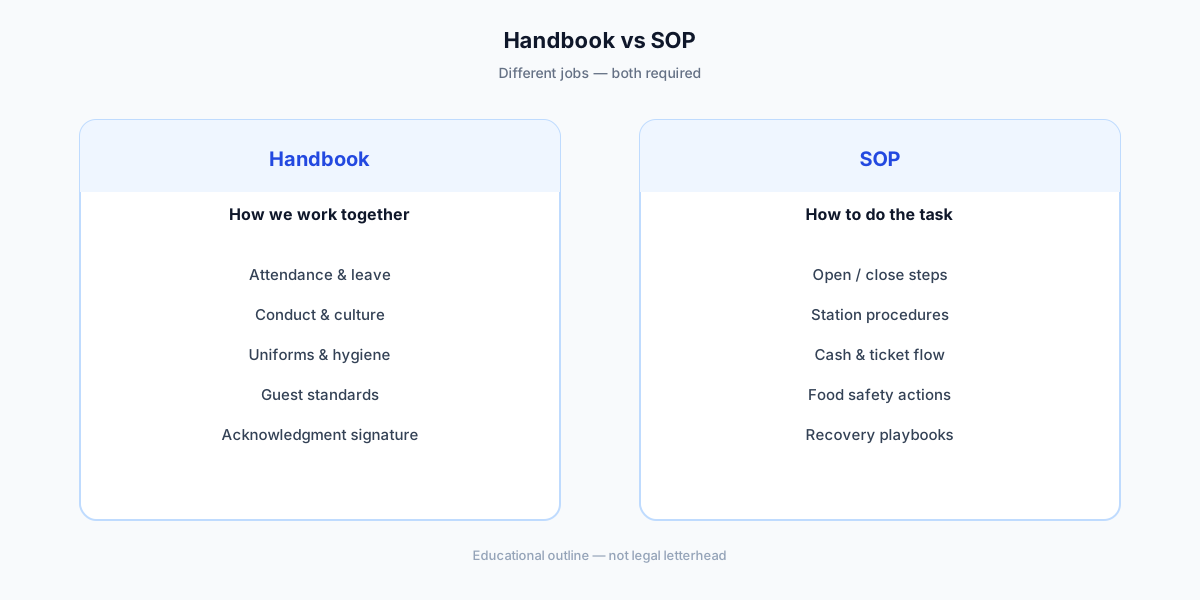
A restaurant employee handbook sets expectations — conduct, attendance, scheduling, appearance, safety, guest standards, and how performance issues are handled — and should be acknowledged in writing. It is not the same as task SOPs:
| Document | Answers |
|---|---|
| Handbook | How we work together / what is expected |
| SOP | How to perform a specific job task |
Build a readable outline, adapt it with qualified local counsel, train managers to apply it consistently, and introduce it during staff training. Keep procedures in your SOP library.
⚠️ Not legal advice. Employment law varies widely by country, state, and city. This outline is educational only. Consult qualified local counsel before publishing or enforcing policies. Tip, wage, leave, and termination rules are especially jurisdiction-sensitive.
Introduction
Verbal rules fail when the team grows past a handful of people. What “everyone knows” becomes three conflicting stories after the second hire. Disputes get personal. Managers improvise. Guests feel the inconsistency.
An employee handbook for restaurants formalizes the basics so onboarding is fair and managers are not inventing policy mid-shift. It should be plain language, short enough to read, and separate from how-to SOPs.
For the wider systems map, see restaurant operations.
Why This Matters
A clear restaurant staff handbook helps with:
| Outcome | Why it matters |
|---|---|
| Fairness | Same rules for full-time and part-time where appropriate |
| Fewer disputes | Expectations were written and acknowledged |
| Clearer manager decisions | Less improvisation under pressure |
| Faster onboarding | Day-0 orientation has a script |
| Safer workplaces | Safety and harassment expectations are explicit |
Handbooks do not replace good management. They give good management a shared baseline.
Step-by-Step Guide: Handbook Section Outline
Use this as a template outline, then localize with counsel.
1. Welcome and mission
- Short welcome from ownership
- What kind of guest experience you stand for
- How the handbook relates to day-to-day work (and that SOPs cover task steps)
2. Employment basics
- At-a-glance employment classifications (as defined under local law)
- Equal opportunity / non-discrimination statement (per local requirements)
- Work authorization / documentation expectations as required locally
- Where to find official job descriptions or role summaries
3. Scheduling and attendance
- How schedules are posted and changed
- Call-out process and timing expectations
- Tardiness and no-show consequences (high level; enforce consistently)
- Shift swap rules (if allowed)
- Link to daily open expectations in the opening checklist
4. Leave and time off
- How to request time off
- Locally required leave types (do not invent — confirm with counsel)
- Holiday / blackout periods if any
5. Pay practices overview
- Pay period and method (high level)
- Tip policy overview if tips apply — structure must match local law; get counsel
- Overtime / break practices as required locally
- Who to ask about pay questions
6. Appearance and uniforms
- Uniform / dress code
- Hygiene standards appropriate to food service
- Name tags / branding rules
7. Guest service standards
- Greeting, phone, and complaint escalation expectations
- Cell phone / personal device use on the floor
- Point to detailed recovery steps in SOPs, not a novel in the handbook
8. Food safety and workplace safety
- Handwashing, illness reporting, allergen awareness (high level)
- Accident reporting
- Emergency procedures pointer
- Zero tolerance for intentional safety violations (define carefully with counsel)
9. Conduct and workplace behavior
- Respectful workplace / harassment policy pointer (must meet local law)
- Theft, violence, substance rules (counsel-reviewed)
- Social media / guest privacy expectations
10. Performance and discipline overview
- Coaching → written warning → further steps (illustrative; must match local law)
- Who conducts reviews
- How to raise concerns
11. Acknowledgment form
- Signature (or digital equivalent) that the employee received and had a chance to ask questions
- Date and version of handbook
- Store with personnel records per local retention rules
Do not paste another industry’s handbook wholesale. Restaurants have tip, scheduling, and food-safety realities that generic templates miss — and legal risk if you copy blindly.
Framework: Handbook Section Map
A restaurant employee handbook is a policy map, not an SOP binder. Use this section order so staff can find answers fast:
| Section | What it covers | What it is *not* |
|---|---|---|
| 1. Welcome + at-will / employment status | How employment works here (jurisdiction-specific) | Not a contract promise |
| 2. Scheduling & attendance | Call-out rules, punctuality, shift trades | Not the daily open checklist |
| 3. Conduct & guest standards | Respect, harassment, phone use, appearance | Not ticket-flow steps |
| 4. Pay, tips, breaks | House rules + legal floor pointers | Not payroll software training |
| 5. Safety & food handling | Non-negotiables + escalate path | Not full recipe cards |
| 6. Uniforms & stations | What to wear / bring | Not mise lists |
| 7. Discipline & acknowledgment | Progressive steps + signature page | Not a substitute for local counsel |
⚠️ Not legal advice. Employment and tip rules vary widely. Have a qualified local professional review before you enforce policies.
Best Practices
- Keep independents to ~15–20 pages of plain language. Longer books do not get read.
- Update annually or when laws/menu/ops change materially. Version every release.
- Train managers on consistent application — uneven enforcement destroys trust.
- Require acknowledgment before floor work for new hires; for existing staff, hold a short meeting and collect signatures.
- Separate handbook from SOPs so policy updates do not bury task steps.
- Align with training — Day 0 of restaurant staff training should include handbook review.
- Avoid policies you will not enforce. Empty threats teach staff to ignore the book.
Plain-language writing tips
- Prefer “Call out at least two hours before your shift when possible” over legalistic walls of text — then have counsel harden the enforceable parts.
- Use examples for gray areas (phone use at the pass vs. on break).
- Put detailed task steps in SOPs; keep the handbook at the policy altitude.
- Include a “who to ask” line in every major section so questions have an owner.
Rollout checklist for existing teams
| Step | Done? |
|---|---|
| Counsel review of draft | ☐ |
| Manager training on consistent application | ☐ |
| All-hands walkthrough of changes | ☐ |
| Acknowledgments collected and filed | ☐ |
| Effective date communicated | ☐ |
| Old version archived | ☐ |
Skipping manager training is how handbooks become fiction on week two.
Common Mistakes
- Copy-pasting another industry’s handbook — wrong norms, possible legal mismatch.
- Policies you will not enforce — selective enforcement creates claims and cynicism.
- No acknowledgment — “I never saw that rule.”
- Handbook contradicts SOPs — e.g. phone rules that conflict with POS procedures.
- Legal overclaiming — promising benefits or procedures you cannot deliver.
- Never updating — stale leave or tip language is a liability and a common ops mistake pattern.
Practical Examples
Example — Attendance policy (pattern) Define what “on time” means, how far in advance to call out, who to notify, and what documentation is required for extended absence. Keep it short enough to read in two minutes.
Example — Tip / service-charge note (pattern) State whether tips are pooled, who is eligible, and that final rules follow local law. Point staff to the posted house tip policy — do not invent numbers in the handbook body.
Example — Safety escalate line “If a cooler is out of range, stop using affected product and call the shift lead immediately.” Link the detailed steps to the food-safety SOP rather than duplicating them.
Action Checklist
- [ ] Draft the seven-section map above in plain language
- [ ] Mark the document “not legal advice” and get local review before enforcement
- [ ] Separate policies (handbook) from procedures (SOP library)
- [ ] Add a signed acknowledgment page for Day-0 onboarding
- [ ] Align attendance and conduct language with how you actually manage
- [ ] Remove any guest PII, wage amounts, or named employee examples
- [ ] Cross-link training and operations pillar
- [ ] Re-issue version date when policies change; collect new acknowledgments
Frequently Asked Questions
Is an employee handbook required by law?
Often not universally required, but many jurisdictions require specific notices or policies. Even when optional, a short handbook is operationally valuable. Ask local counsel what is mandatory for your location.
What’s the difference between a handbook and SOPs?
Handbook = expectations and policies. SOPs = step-by-step task standards. You need both for solid restaurant operations.
What attendance rules work for restaurants?
Clear call-out timing, consistent consequences, and a documented swap process. Exact thresholds must fit local law and your service model — counsel should review.
Should tip policies be in the handbook?
If tips are part of compensation, a clear, lawful tip policy overview belongs in the handbook. Tip pooling and service charges are heavily regulated in many places — do not improvise.
How do I introduce a new handbook to existing staff?
Announce why it exists, walk through changes in a short meeting, answer questions, collect acknowledgments, and give a reasonable effective date. Do not surprise people mid-pay-period with silent changes to pay practices.
How often should the handbook be updated?
At least annually, plus whenever laws or major policies change. Retire old versions; keep a revision log.
Do part-time staff need the same handbook?
Usually yes for conduct, safety, and guest standards. Classification-specific sections should reflect local law. Consistency reduces confusion.
Related Guides
- Restaurant Operations — Ops stack overview
- Restaurant Staff Training — Where handbook acknowledgment fits onboarding
- Restaurant SOP Guide — Task procedures (separate from policy)
- Restaurant Opening Checklist — Attendance and open readiness
- Common Restaurant Mistakes — Hiring without clear expectations
- Restaurant Knowledge Hub — Ops + Growth lanes
- About WhateverAsk — Editorial standards and who we write for
Conclusion
An employee handbook for restaurants makes expectations visible, fair, and trainable. Keep it short, counsel-reviewed, acknowledged, and separate from SOPs. Then train managers to apply it the same way every shift. That is how policy supports operations instead of sitting in a drawer.
Last Updated
2026-07-10. Educational outline only — not legal advice. Employment, wage, tip, leave, and termination rules vary by jurisdiction. Consult qualified local counsel before publishing or enforcing any handbook.